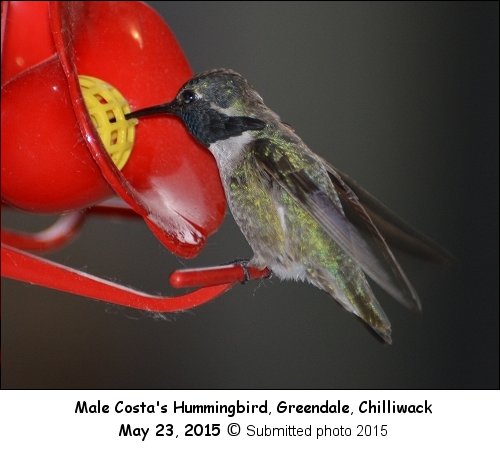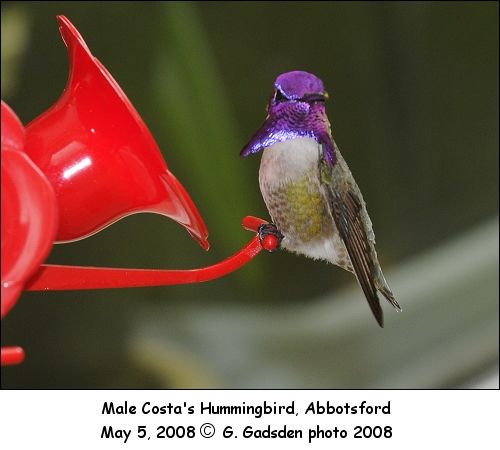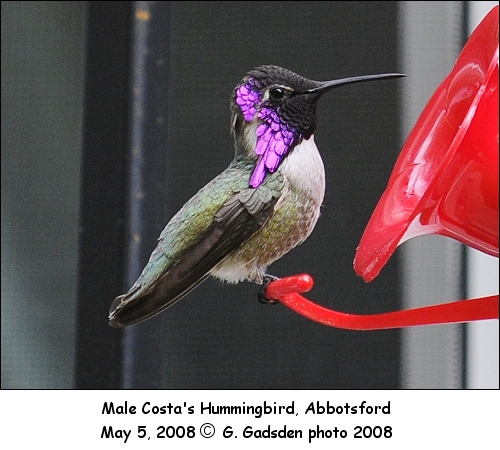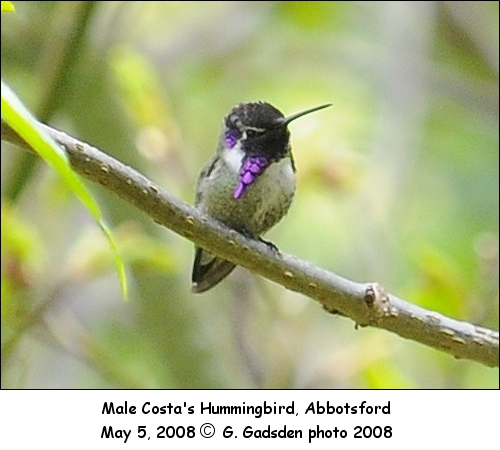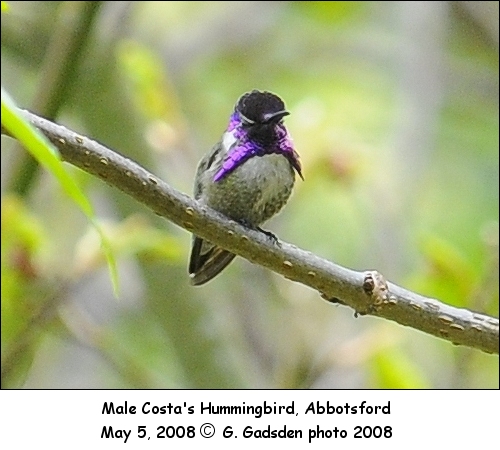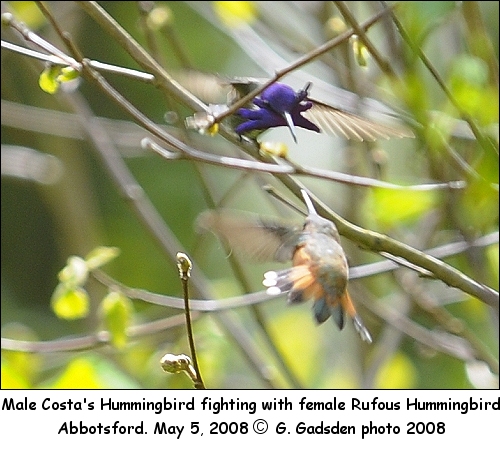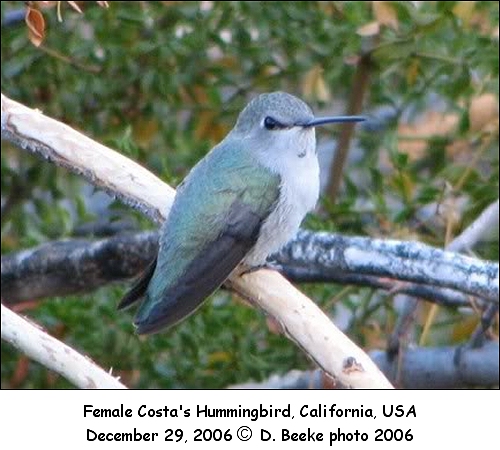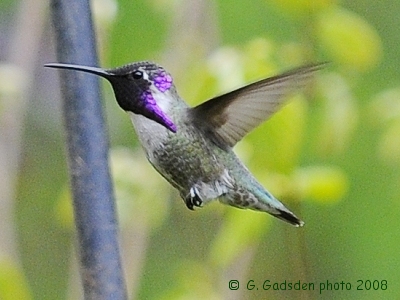

This hummingbird is actually smaller than Rufous Hummingbirds and is typically found in California south through Mexico. We have four records in the books for this species in the checklist area of birds that have wandered well north of their typical stomping grounds. All records are in the spring of males that visited hummingbird feeders for periods between five and ten days before apparently moving on and/or being displaced by resident hummingbirds.
Similar species:
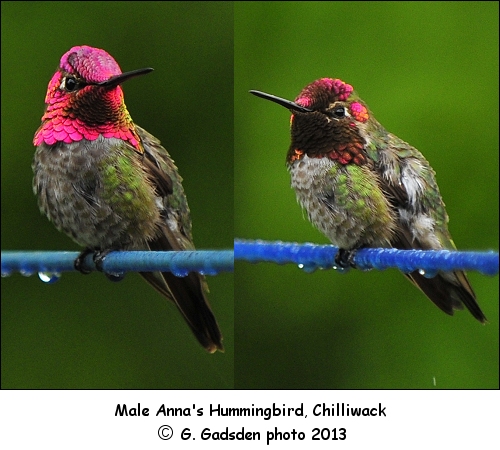
While in the same genus as the Anna’s Hummingbird, these two species should be fairly easlily told apart based on size, and body structure and markings. Note on males the throat feathers (gorget) are differently shaped and in the right light, with different colours. The wingtips on a perched Costa’s Hummingbird will extend just past the tip of the tail while on the Anna’s, its long tail projects well beyond the wingtips. Costa’s Hummingbird appears to be a stocky and large-headed bird. See photos below. Females are more difficult to identify. Hummingbirds in general can be challenging to identify in the field due to their quick flight and small size. Costa’s Hummingbird and even other accidental species may be overlooked much of the time due to this fact.
Sources:
Ehrlich, Dobkin and Wheye, (1988)
Sibley, D. 2000
Noteworthy Data
Date | Location | Source(s) | Comments |
| May 14, 2015 | Greendale, Chilliwack | G. Gadsden 2015e | A male that was a daily visitor to a private property's feeders until May 23, 2015. Photo posted below. |
| April 30, 2008 | Eagle Ridge, Abbotsford | A & L Doeksen C. Jury 2008 | A male came to backyard feeders until May 6, 2008. Photographed (see below). |
| April 1, 2000 | Ryder Lake, Chilliwack | D. Knopp 2000 J. Osterhold | Remained until April 10, 2000. A male photographed and seen by several observers. |
| May 15, 1999 | Deerfield Crescent, Chilliwack | B & J Skimming D. Knopp 1999a | A male photographed and seen by several observers. Remained until May 20, 1999. |
Photos